


Aspects of a Planet
In astrology, "planets" refer to celestial bodies like the Sun, Moon, Mercury, Venus, Mars, Jupiter, Saturn, and the lunar nodes (Rahu and Ketu), each associated with distinct aspects of personality and life, such as the Sun with identity, the Moon with emotions, and Mars with drive. "Aspects" are the angular relationships between these planets in a birth chart, revealing how their energies interact, with conjunctions, squares, oppositions, trines, and sextiles indicating cooperative or challenging dynamics.
Planets and Their Aspects in Astrology
-
Sun: Represents core identity, confidence, vitality, and leadership.
-
Moon: Symbolizes emotions, intuition, nurturing, and the inner self.
-
Mercury: Governs communication, intellect, learning ability, and logic.
-
Venus: Associated with love, beauty, relationships, pleasure, and values.
-
Mars: Signifies drive, energy, courage, action, and aggression.
-
Jupiter: Represents growth, expansion, wisdom, luck, and spirituality.
-
Saturn: Symbolizes discipline, responsibility, hard work, lessons, and karma.
-
Rahu & Ketu: The lunar nodes; Rahu represents wants and materialism, while Ketu symbolizes spiritual detachment and intuition.
Every planet, regardless of its position, aspects the 7th house from where it is placed. This means a planet’s energy extends directly opposite to its position. For example, if the Sun is in the 1st house, it will aspect the 7th house. If the Moon is in the 5th house, it will aspect the 11th house.
Only Mars, Jupiter, and Saturn have extra aspects beyond the 7th. Sun, Moon, Mercury, and Venus do not
Types of Aspects
-
Harmonious Aspects: Energies that flow easily and foster positive outcomes (e.g., Trine and Sextile).
-
Disharmonious Aspects: Energies that are dynamic, creating challenges and conflicts (e.g., Square and Opposition).
-
Neutral Aspects: Energies that are in the same location or degree, creating a strong combination (e.g., Conjunction).
Aspects of all planets
Every planet aspects the 7th house (sign) from its position, but Mars, Jupiter, and Saturn have additional special aspects: Mars aspects the 4th and 8th, Jupiter aspects the 5th and 9th, and Saturn aspects the 3rd and 10th houses from its position. These aspects (or drishtis) reveal interactions between planets, with their nature (benefic or malefic) and strength dependent on the planet's characteristics.
Special Aspects by Planet:
-
Mars: Casts full aspects on the 4th, 7th, and 8th houses from its placement.
-
Jupiter: Casts full aspects on the 5th, 7th, and 9th houses from its placement.
-
Saturn: Casts full aspects on the 3rd, 7th, and 10th houses from its placement.
Other Planets:


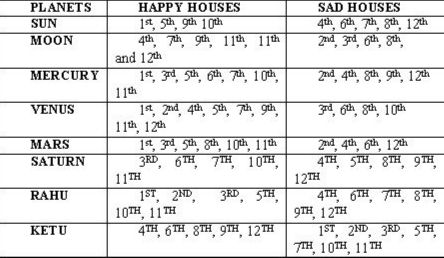
Nature of Aspects:
-
Benefic Planets (Jupiter, Venus, Mercury, well-placed Moon):
Provide beneficial, comforting, or favorable effects on the houses they aspect.
-
Malefic Planets (Saturn, Mars, poorly-placed Sun, Rahu, Ketu):
Create stress, pressure, fear, conflict, or delays in the houses they aspect.
Interpreting Aspects:
-
Strength:
The strength of an aspect is determined by the planet's nature and position.
-
Interactions:
When a planet occupies one of the houses aspected by another planet, the two planets interact, and the aspecting planet's nature is applied to the planet in the house it is aspecting.
-
Full Aspect vs. Partial Aspect:
All planets aspect the 7th house (180 degrees). The additional aspects of Mars, Jupiter, and Saturn are considered full aspects.

